


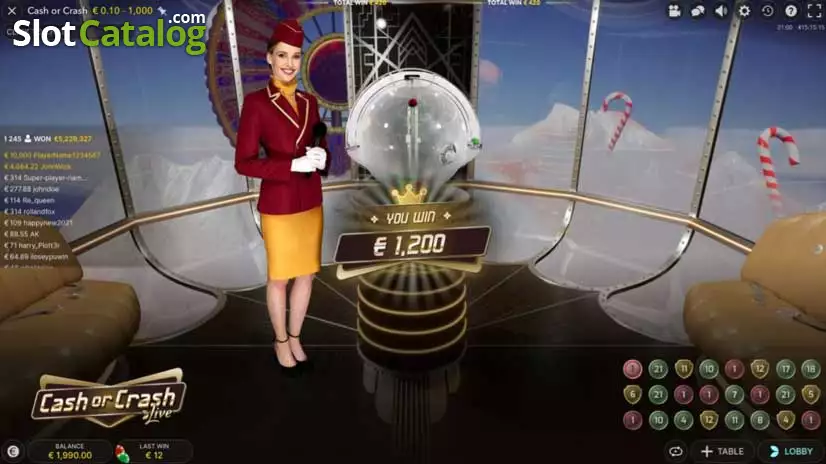
Cash or Crash Live carves its own space in the realm of live game shows https://cashorcrashcasino.com. Its appeal is found in a strong combination of studio spectacle and game design that turns every round into a personal test of nerve. This is no a passive spin of a wheel of chance. In this experience, you are in control, making active choices that determine your winnings. The premise draws you in with a climbing multiplier, then challenges you to take it before a hidden “crash” resets everything. To maximize your experience, you should see beyond the flashy show and see how it actually works. Let’s examine the phases, the presenter’s part, the odds involved, and the strategies players can use to manage the excitement.
The Primary Purpose and Core Mechanics
The goal of Cash or Crash Live is simple on the appearance. You need to decide when to cash out a rising multiplier before a concealed “crash point” ends the turn and takes your winnings for that level. Each game starts with players making bets. A rocket then launches its ascent, and a multiplier starts climbing from 1x. The ride has various levels. Before launch, a unknown crash multiplier is chosen for every stage, hidden from nobody. As the multiplier increases, every player chooses to hit “Cash Out,” locking in that multiplier on their stake, or to continue. If the rocket reaches the unknown crash point prior to a player exits, they forfeit their wager for that stage. This cycle of risk and reward occurs over multiple stages. Those who endure build their winnings incrementally.
Dissecting the Game Phases
Consider the game as a series of separate segments, each a new bet. Surviving a crash doesn’t eliminate you. You move to the next stage with your built-up winnings intact, then begin the risk process from scratch on the next segment of the rocket’s journey. This structure is critical. It generates a story, with tension that builds as you go. The presenter amplifies the excitement, revealing how many players are still staying on the rocket as the multiplier achieves scary levels. Initial phases often see cautious plays. Subsequent phases, with their high-stakes multipliers, entice you to risk the gains you’ve previously won. This segmentation is the core of the game’s appeal. It creates a series of individual, stressful decisions instead of just one.
From Green to Red: The Risk Escalation
Notice the color-coded path the rocket follows. It’s a key part of the game’s vocabulary. The opening segment is usually a “Green Zone,” a safer phase where a crash is still on the table. Then, the rocket could move into an “Amber Zone,” a clear signal that hazard is growing. The concluding section is the “Red Zone.” At this point, multipliers appear their most attractive, but the probability of a crash is mathematically at its peak. Such visual cues are more than decoration. They give you a immediate indicator for the hazard level at each instant. They transform an abstract probability become concrete. Knowing the game is deliberately alerting you about increasing uncertainty is a essential piece of game strategy.
Mathematical Foundations and Volatility
Let’s consider the numbers that make the game tick. The crash point for each stage is based on a set statistical distribution. Regular, low multipliers such as 1.2x or 1.5x have a high chance of being selected. Very large multipliers can occur, but are exponentially less likely. This design ensures the game stable. The regular, small crashes fund the rare, huge potential payouts. The “Return to Player” (RTP) is a theoretical percentage over millions of plays. In your single session, the fluctuations are dramatic. You’re not wagering against the house in a traditional way. You are making decisions against a hidden, random number. Remember these points:
- Separate Rounds: Each level’s crash value is a separate event. A 1.2x crash in the first stage does not predict the second.
- No Forecasting Ability: The RNG eliminates any predictable patterns. Previous crashes or large wins do not affect future rounds.
- House Advantage: The game is designed with an inherent house edge, which is evident in the provider’s published RTP.
The purpose of the presenter and RNG
The presenter goes beyond talk. They establish the game’s emotional pace. While they can’t affect the result, they skillfully build suspense. They shout out the climbing multiplier and offer live updates on what percentage of the crowd is cashing out at each level. That social cue can mess with your head. But remember, the host operates independently of the game’s engine: the Random Number Generator (RNG). The crash point for each stage is determined by a certified RNG the instant the stage begins. This ensures fairness and total unpredictability. The host has no clue when the crash will happen. Their job is entertainment. The RNG’s job is certifiable fairness. This combination merges transparent live action with provably random results.
Strategic Frameworks and User Behavior
No strategy can defeat the fundamental randomness. But you can apply systematic techniques to manage your money and your feelings. The main conflict is a exchange. Do you lock in assured gains, or pursue explosive profits? Gamblers often use methods like the “Fixed Cash-Out.” Here, you decide ahead of time to cash out at a specific multiplier, say 2x, in every stage. This aims for consistent, small wins. The opposite is the “Let It Ride” method, where you gamble several rounds for a shot at a massive win, acknowledging that failures will occur. A more strategic method is the “Percentage Bankroll” system, where you adjust your wager amount based on your current winnings. The biggest factor, though, is in your psychology. Can you fight the “greed factor” when the ratio rises? Can you avoid annoyance after an early crash? Your best weapon is setting firm guidelines for yourself before the session even launches.
Common Pitfalls to Steer Clear Of
Look out for a few typical blunders. The most destructive is “chasing” a failure. This signifies recklessly increasing your wager after a setback, which goes against the game’s round-independent design. Another mistake is believing in the “hot hand” misconception, thinking a sequence of big payouts is expected to persist. Permitting the host’s talk or the actions of other players pull you away from your own predetermined strategy is widespread. Also, do not misunderstand the zones. The Amber and Red Zones aren’t challenges to beat. They are warnings that the hazard has jumped. Going into any phase without a defined objective turns the game from a process of judgment into a sheer emotional ride. That ride hardly ever concludes favorably.
Finale: A Blend of Fortune and Choice
Cash or Crash Live is a captivating mix of sheer chance and intentional choice. Its structure are structured to weave a tale of rising stakes, powered by a transparent RNG and livened by a charismatic presenter. Measuring success as a entertaining and potentially lucrative session depends on several factors. It’s less about forecasting the uncertain and instead about understanding how the game is built. It calls for managing your bankroll with restraint and managing the psychological urges the game skillfully stimulates. By mastering its levels, understanding its mathematical structure, and following a custom strategy, you can alter your outlook. You go from puzzled guesswork to enlightened engagement in a exceptionally intense live game show.
